
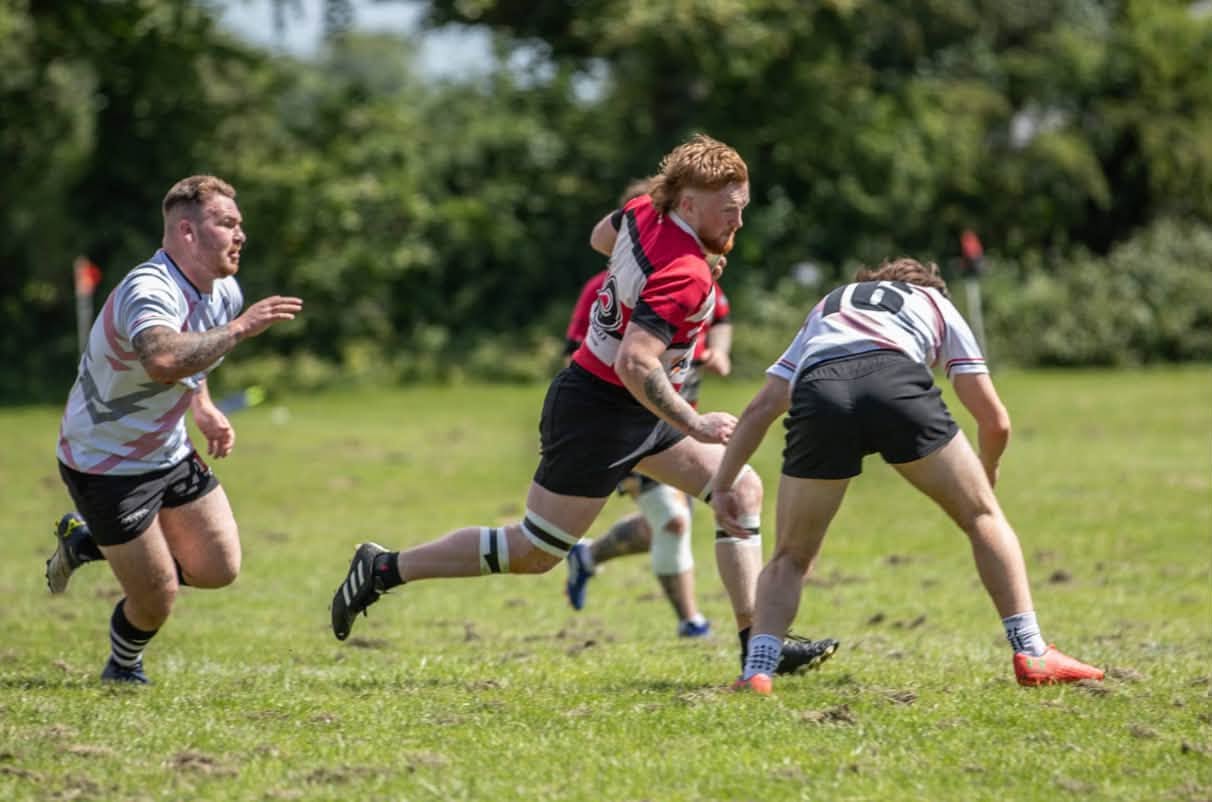
Hard ground and rugby: what actually changes when the pitch gets firmer?
When rugby pitches dry out, it is common to hear the same complaints: tight calves, sore hamstrings, groin soreness and players generally feeling more beaten up after training or matches.
I have covered several of those individual injuries elsewhere. So rather than going over the same ground again, I want to look at the problem from the other direction.
What actually changes when the pitch itself becomes harder?
It sounds like a simple question, but the biomechanics are more interesting than “hard ground means more impact”.
The surface beneath a rugby player affects how much the ground deforms, how the boot grips and releases, and potentially how the player runs, accelerates, stops and changes direction.
Those factors may influence the loads experienced by the body. Importantly, however, rugby research has not shown that hard ground directly causes a particular calf, hamstring or groin injury.
So let’s look a little deeper.
Does hard ground actually increase rugby injuries?
There is some evidence that it might.
A New Zealand study involving more than 1,000 rugby union players found that injuries were more likely in matches played on subjectively rated hard ground. The association remained after the researchers accounted for factors including age, grade, playing position, rugby experience and player preparation.1
A study of semi-professional rugby league also found that harder ground conditions were associated with a greater risk of match injury, although the same relationship was not seen during training.2
However, there is an important problem with much of this research:
What exactly counts as a hard pitch?
Many studies have relied on somebody describing the ground as hard, firm, soft or heavy rather than objectively measuring its mechanical properties. A systematic review of the research highlighted this as an important limitation.3
One rugby union study did something more useful. Takemura and colleagues objectively measured ground hardness throughout a season while recording injuries in 271 premier-grade rugby players. Both ground hardness and injury incidence were higher earlier in the season and decreased as the season progressed.4 But once the researchers accounted for the stage of the season, ground hardness itself was not a statistically significant independent predictor of injury. 4
This does not mean hard ground is irrelevant. It means the relationship is probably more complicated than: hard pitch → injury. And that is where the biomechanics become interesting.
1. Hardness changes how the surface deals with impact
A softer natural surface can deform beneath a player. A firmer surface generally deforms less. It is tempting to conclude that every step on hard ground therefore sends substantially greater forces through the ankle, knee and hip. The evidence is not quite that simple.
A systematic review examining running biomechanics found significantly greater peak tibial acceleration – essentially the acceleration measured through the shin – on harder surfaces. However, it found no significant differences between hard and soft surfaces in peak vertical ground reaction force or loading rate.5
That research involved running rather than rugby, so we cannot simply transfer the findings directly to a rugby match. It does, however, demonstrate why the common idea that a hard pitch simply “sends more force up the leg” is probably too crude. Different aspects of mechanical loading can respond differently to the same change in surface.
And rugby is considerably more complicated than steady running. Players accelerate, sidestep, decelerate, jump, land, tackle and collide. Each of those actions creates a different interaction between the player and the ground.
So surface hardness matters, but how the player interacts with that surface may matter just as much.
2. Hardness and grip are not the same thing
This is perhaps the most useful distinction for rugby players.
We often describe a pitch using one word: “It’s hard.”
But surface hardness and traction are not the same property.
Traction describes the grip between the boot and the ground. That interaction depends not only on the pitch, but also on moisture, grass coverage and the design and configuration of the studs beneath the boot.
Rugby-specific research gives us a useful example.
In 2014, Ballal and colleagues tested five different eight-stud rugby boots on natural grass and measured their rotational stiffness and peak torque – essentially how strongly each boot resisted twisting against the surface.6
The five boots were:
- Adidas AdiPure Regulate
- Canterbury Stampade Club 8 Stud
- KooGa EVX II LCST
- Mizuno Fortuna SI Rugby
- Puma Esito Finale H8
All were eight-stud soft-ground rugby boots, but they did not behave in the same way mechanically. 6
The Canterbury Stampade Club 8 Stud produced the highest rotational stiffness and peak torque of the boots tested. It also had the longest studs in the study, at 18 mm. At the other end of the range, the KooGa EVX II LCST produced the lowest rotational stiffness.6
That does not mean the Canterbury was the “best” boot. Nor does it mean the KooGa was safer.
The study measured the mechanical behaviour of the boots against natural turf. It did not measure injury rates, comfort or overall rugby performance. The Canterbury result simply means that, under the conditions tested, it resisted twisting against the playing surface more strongly.
That distinction matters.
Greater rotational resistance may be useful during some rugby tasks where stability and traction are important. During running, sidestepping or rapid changes of direction, however, high resistance to rotation may create a different mechanical demand.
The 2014 study did not determine which level of rotational resistance was optimal for an individual player or position. 6 Its most useful finding for rugby players is therefore not that one boot “won”. It is that rugby boots designed for apparently similar conditions can interact quite differently with the same natural-grass surface.
That becomes particularly relevant when a player plants a foot to change direction.
If the boot releases relatively easily, some rotational movement can occur between the shoe and the ground. If the boot resists rotation more strongly, more of that movement may instead have to be managed through the foot, ankle, knee and the rest of the lower limb.
Evidence from other football codes suggests this may matter.
A systematic review examining shoe–surface traction identified three prospective studies linking higher rotational traction with lower-limb injury. Importantly, all three injury studies involved American football players rather than rugby players.7 Across those studies, higher rotational traction was associated with approximately 2.7 times greater odds of lower-limb injury. 7
We cannot assume that the same magnitude of risk applies to rugby.
But when considered alongside the rugby-specific footwear study, it supports an important biomechanical principle:
more grip is not automatically better.
So rather than asking only:
“How hard is the pitch?”
it may sometimes be more useful to ask:
“How is my boot interacting with this pitch today?”
Does that mean more grip is bad?
No.
Rugby players need sufficient traction to accelerate, sidestep, scrummage, drive through contact and maintain their footing. The issue is not that grip is inherently dangerous. It is that the relationship between too little, appropriate and excessive traction is more complicated than assuming maximum grip must always be best.
There is currently no good rugby evidence showing that a particular stud length or configuration will prevent injury.
The Ballal study is a good example of why simple rules can be misleading. Five boots designed for broadly similar rugby conditions produced noticeably different rotational characteristics on the same natural surface. 6 Stud length is only part of that interaction. Stud diameter, shape, layout, surface moisture, soil and grass conditions may all contribute.
So I would be cautious about advice such as always choosing longer studs to obtain more grip. The more sensible approach is to select footwear appropriate for the actual surface, the player’s position and the movements they are going to perform.
3. Could hard ground change how fast rugby is played?
There is another possible mechanism.
Rugby researchers have suggested that harder surfaces could influence injury indirectly if they allow players to move faster because less energy is lost through surface deformation.3 4 If running speeds increase, that could potentially change the demands of acceleration, deceleration and changes of direction. It could also alter the speeds involved when players enter contact.
Notice the wording: could.
This is a plausible biomechanical mechanism, not something rugby research has conclusively demonstrated.
But it raises a much more interesting question than simply asking whether a hard pitch produces more impact. Perhaps a firm surface does not just change the forces beneath the foot. It may also change what a rugby player is able to do on that surface.
A slightly faster acceleration, a harder deceleration or a more aggressive change of direction could potentially alter lower-limb loading considerably. We still need better rugby-specific research to establish whether that actually translates into particular injury patterns.
A rugby pitch is not actually one surface
There is another problem with saying: “The pitch was hard”.
Which part?
A goalmouth may behave differently from the halfway line. A heavily used training channel may be different from the touchline. Shade, drainage, grass coverage, soil composition, irrigation and previous use can all affect the mechanical properties of natural turf.
Recent research objectively measuring sporting fields found substantial differences in surface hardness both between different pitches and within individual pitches.8 The researchers also found that harder conditions were generally associated with greater sensor-measured lower-limb impact loading during sporting drills. 8
One of the natural-grass surfaces in the study was a rugby training field, although the participants themselves were not specifically rugby players. The study also did not measure injury occurrence.
So it cannot tell us that harder areas of a rugby pitch cause more injuries.
What it does demonstrate is something simpler but important: the mechanical surface beneath a player can change as they move around the same pitch.
Calling an entire pitch simply “hard” may therefore hide quite a lot of variation.
What does this mean for rugby players?
The practical message is not that players should be frightened of firm pitches. It is that surface conditions form part of the overall physical environment in which rugby is being played.
If you have spent much of pre-season on one type of surface and then suddenly train or compete on a much firmer pitch, the interaction between your running, your footwear and the ground has changed.
The warm-up is therefore a useful opportunity to experience the actual playing surface. Rather than judging the pitch from a gentle jog around the touchline, gradually expose yourself to some of the movements the match will require: acceleration, deceleration and changes of direction.
It is also worth paying attention to how your boots actually feel on that particular surface.
Do they feel secure, or does the foot slip?
Do they feel unusually fixed when you plant and turn?
Those observations cannot calculate injury risk, but they may be more useful than simply looking at the pitch and deciding that it is “hard”.
And look for patterns.
If your calf, hamstring, groin, Achilles tendon or foot repeatedly becomes symptomatic when pitch conditions change, simply blaming the ground may miss other factors worth considering.
These could include previous injury, strength and physical capacity, current sprint exposure, recent changes in training, footwear and recovery between matches. Those are reasonable clinical considerations rather than proof that altering any single one will prevent injury.
So, does hard ground cause rugby injuries?
The most accurate answer at present is more nuanced than either yes or no.
Some rugby studies have found more injuries on harder pitches. 1 2 However, research using objective measurements has not demonstrated that ground hardness itself is an independent predictor of injury once factors such as the stage of the season are considered. 4
What we can say more confidently is that changing the playing surface changes the player–surface interaction.
Surface firmness affects how much the ground deforms. Boot and stud design can influence traction and rotational resistance. 6 Different surfaces may alter some measures of lower-limb loading. 5 8 And the combination of these factors may influence how a player accelerates, decelerates, changes direction and enters contact.
We still do not have good rugby-specific evidence showing that firm natural ground directly causes calf, hamstring or groin strains.
But that does not mean the pitch should be ignored.
It means we need to look at it through a slightly different lens.
When should you get an injury assessed?
General post-match stiffness that settles over the following couple of days is different from a clear injury.
Consider assessment from an appropriately qualified healthcare professional if you develop sharp or localised pain, significant swelling or bruising, loss of strength or movement, repeated symptoms when sprinting or changing direction, or pain that is worsening rather than settling.
Following a significant acute injury, inability to bear weight, obvious deformity, severe pain, suspected fracture, or concerning head, neck or neurological symptoms requires more urgent medical assessment. An osteopathic or sports injury assessment may also be useful when symptoms repeatedly return with rugby exposure. The aim is not simply to look at the painful area, but to consider the injury alongside the player’s physical capacity and the demands they are trying to return to.
Frequently asked questions
Is hard ground proven to cause more rugby injuries?
No. Some rugby studies have found an association between harder ground and injury, while others have not found ground hardness to be an independent risk factor. The methods used to assess pitch conditions have also varied considerably.
Does a harder pitch put more force through your legs?
It can alter some measures of impact, but “harder ground equals more force through the body” is an oversimplification. Running research has found greater tibial acceleration on harder surfaces without significant increases in some other commonly measured loading variables.
Does the type of rugby boot really make a difference?
Yes, mechanically it can. A 2014 study testing five eight-stud rugby boots found significant differences in rotational stiffness and peak torque when they were tested on natural grass. However, the study did not establish that one boot was safer or better overall.
Which boot had the greatest grip in the 2014 rugby study?
The Canterbury Stampade Club 8 Stud produced the greatest rotational stiffness and peak torque in the study.[6] This means it resisted twisting against the surface more strongly. It does not mean that it was necessarily the best-performing or safest boot.
Are long studs dangerous on hard ground?
There is not enough evidence to say that a particular stud length is inherently dangerous. Stud length is only one factor affecting the interaction between the boot and surface, and rugby research has not established a specific stud configuration that prevents injury.
Can hard pitches cause calf, hamstring or groin strains?
Changing surface conditions may plausibly alter lower-limb loading, but rugby studies have not demonstrated that hard natural pitches specifically cause calf, hamstring or groin strains.

Returning to rugby after an injury?
If calf pain, hamstring tightness, groin symptoms or another rugby injury is limiting your training or matches, learn more about sports injury treatment in Orpington or book an appointment for an individual assessment and rehabilitation advice.
About the author
David Hanaie M.Ost is a registered osteopath and provides pitch-side and rehabilitation support within rugby. At Resilience Osteopathy, he also provides osteopathic care in Orpington for people experiencing sports injuries, musculoskeletal pain and difficulties returning to exercise.
Resilience Osteopathy
Orpington, Kent
References
- Alsop JC, Morrison L, Williams SM, Chalmers DJ, Simpson JC. Playing conditions, player preparation and rugby injury: a case-control study. J Sci Med Sport. 2005;8(2):171-180. doi:10.1016/S1440-2440(05)80008-8. ↩︎
- Gabbett T, Minbashian A, Finch C. Influence of environmental and ground conditions on injury risk in rugby league. J Sci Med Sport. 2007;10(4):211-218. doi:10.1016/j.jsams.2006.11.003. ↩︎
- Petrass LA, Twomey DM. The relationship between ground conditions and injury: what level of evidence do we have? J Sci Med Sport. 2013;16(2):105-112. doi:10.1016/j.jsams.2012.07.005. ↩︎
- Takemura M, Schneiders AG, Bell ML, Milburn PD. Association of ground hardness with injuries in rugby union. Br J Sports Med. 2007;41(9):582-587. doi:10.1136/bjsm.2007.035568. ↩︎
- Mitchell C, McDonnell S, Oganezova K, Mockler D, Fleming N. The effect of surface compliance on overground running biomechanics: a systematic review and meta-analysis. Sports Biomech. 2025;24(5):1143-1167. doi:10.1080/14763141.2023.2236058. ↩︎
- Ballal MS, Usuelli FG, Montrasio UA, Molloy A, La Barbera L, Villa T, et al. Rotational and peak torque stiffness of rugby shoes. Foot (Edinb). 2014;24(3):107-110. doi:10.1016/j.foot.2014.06.006. Available from:
https://re.public.polimi.it/retrieve/e0c31c0d-c088-4599-e053-1705fe0aef77/Rotational%20and%20peak%20torque%20stiffness%20of%20rugby%20shoes_11311-857534_Villa.pdf ↩︎ - Thomson A, Whiteley R, Bleakley C. Higher shoe-surface interaction is associated with doubling of lower extremity injury risk in football codes: a systematic review and meta-analysis. Br J Sports Med. 2015;49(19):1245-1252. doi:10.1136/bjsports-2014-094478. ↩︎
- Veith A, McCall D, Sandor D, Straw C, Williams J, Challis JH. Within- and between-field variability in natural turfgrass and synthetic turf is associated with differences in athlete mechanical loading and perception. Front Sports Act Living. 2026;8:1876412. doi:10.3389/fspor.2026.1876412. ↩︎
Why people choose Resilience Osteopathy

Considered
local osteopathic care
Your symptoms, concerns, work, sport and daily activity all matter. Care is tailored to you and your individual goals.

Hands-on
osteopathic treatment
Treatment may include hands-on techniques to support comfort, mobility and movement, depending on your assessment findings.

Read about
sports injury treatment
Find out more about osteopathic care for sports injuries in Orpington and what treatment may include.

Assessment and diagnosis
where appropriate
Your appointment includes a case history and physical assessment to help understand what may be contributing to your symptoms.