
Rugby concussion: can neck strengthening help reduce the risk?
A practical guide for community rugby players, coaches and parents on what neck exercises may offer, what the research actually found, and why safe tackle technique and RFU concussion management still matter.
Key points
- No exercise or strengthening programme can make a rugby player concussion-proof.
- A community-rugby study found a 60% lower concussion incidence in players completing a whole-body programme that included neck conditioning.
- The study did not test neck exercises alone, so neck strengthening cannot be credited with the reduction by itself.
- Neck exercises should be controlled, introduced progressively and used alongside whole-body preparation and safer tackle coaching.
- A player with a suspected concussion should be removed from play immediately and managed according to current RFU guidance.
Concussion is part of rugby’s risk – but it should never be dismissed
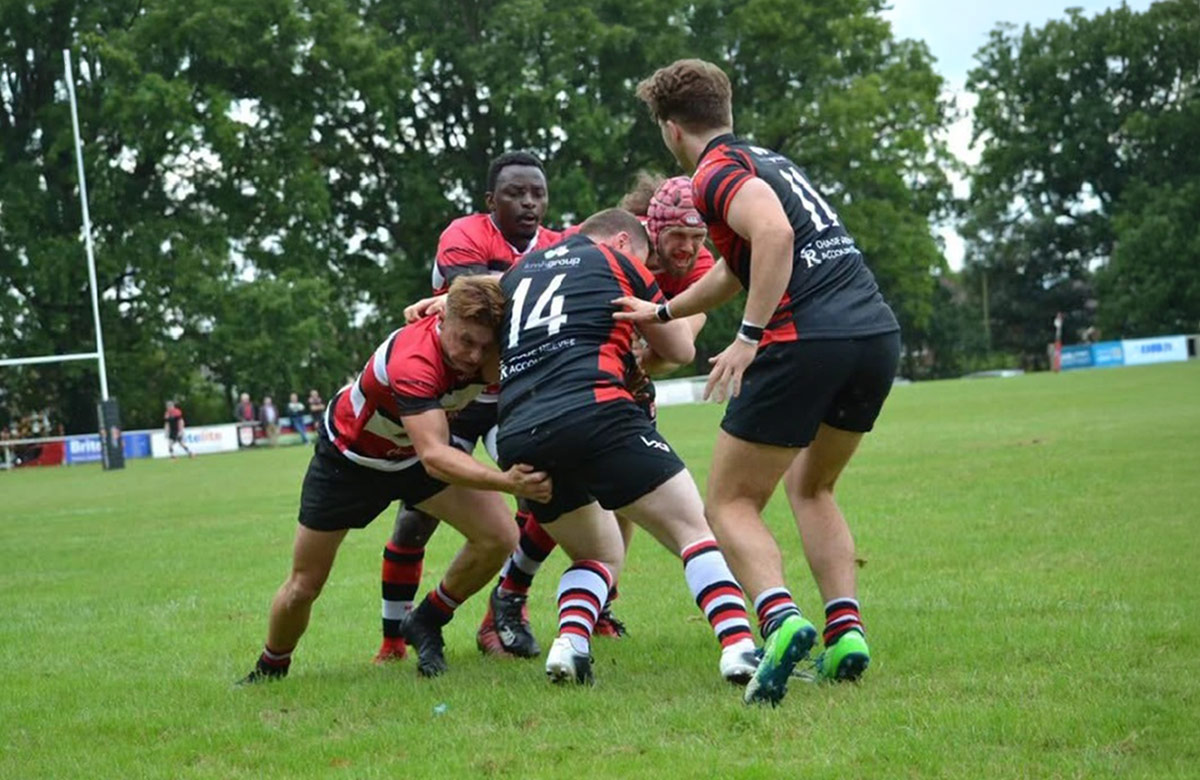
Rugby is a physical, fast-moving contact sport. Tackles, rucks, mauls and accidental collisions can all expose a player’s head to sudden forces. A concussion can follow a direct blow to the head, but it can also occur when an impact to the body causes the head and brain to move rapidly.
The player does not have to be knocked unconscious. They may remain on their feet and still develop headache, dizziness, confusion, balance problems, visual disturbance, nausea, unusual tiredness or difficulty remembering what happened.
That is why prevention is not simply about avoiding obvious head-to-head impacts. It also involves preparing players physically, teaching safer contact skills and creating a culture in which symptoms are reported rather than hidden.
Can concussion be completely prevented?
No. There is no exercise, helmet, mouthguard or strengthening programme that can make a rugby player “concussion-proof”. The aim is to reduce avoidable risk and improve the player’s ability to control their body and head during contact.
One area that has received attention is neck conditioning. The muscles around the neck help support the head. In theory, a stronger and more responsive neck may help a player control rapid head movement when a collision occurs. This does not mean a strong neck will stop every concussion, but neck training may be one useful part of a broader injury-prevention programme.
What did the community rugby research find?
A large study involving adult men’s community rugby clubs tested a progressive movement-control warm-up against a control warm-up. The intervention was a whole-body programme. It included balance, proprioception, resistance work, landing, cutting, plyometric exercises and neck conditioning – not neck exercises alone.
The group completing the intervention experienced a 60% lower concussion incidence than the control group. There were 1.2 concussions per 1,000 player match-hours in the intervention group, compared with 3.4 per 1,000 player match-hours in the control group. The researchers described this as a “very likely beneficial” result. Concussion burden, measured through days lost, was also approximately 60% lower.1
The researchers suggested that the isometric neck exercises included throughout every phase of the intervention may have contributed to the result. However, the study did not test neck training on its own. We therefore cannot say that the neck exercises alone caused the 60% reduction.
The simple message
The research programme trained the whole body, while the exercise shown below was the part designed specifically to improve neck strength and control.
The neck-specific exercise used in World Rugby Activate
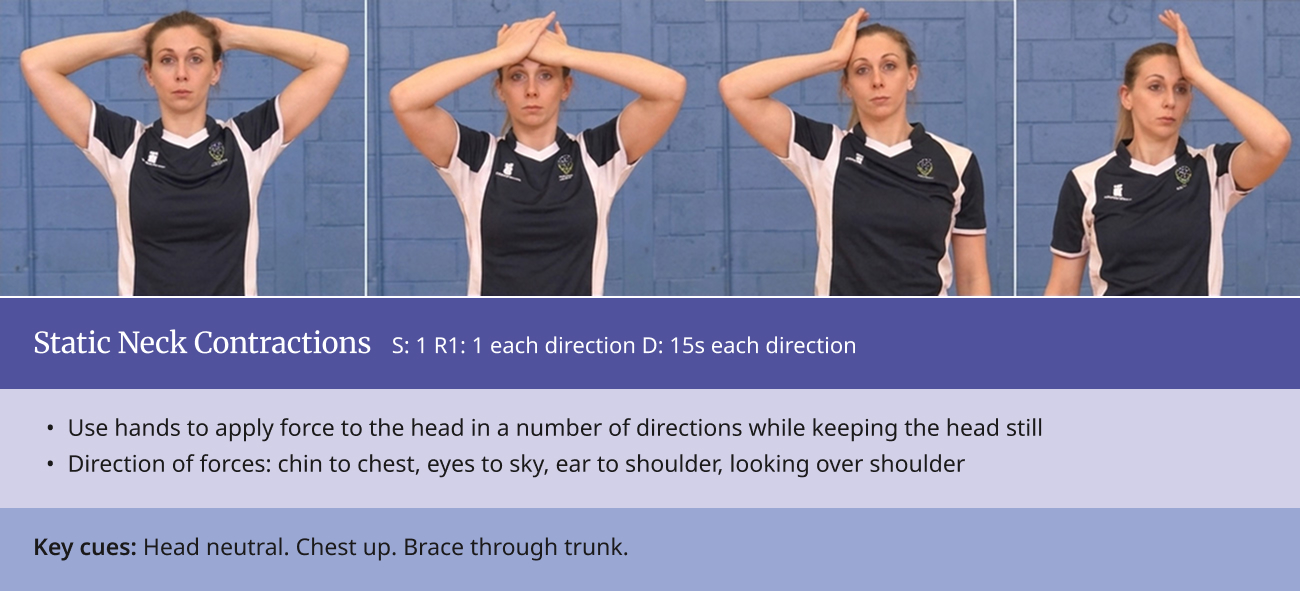
World Rugby’s Activate programme is a full warm-up for the whole body. Within that programme, the exercise below is specifically labelled as an exercise to improve neck strength and function.2
How to perform the static neck contractions
This is an isometric exercise. That means the neck muscles work against resistance, but the head should not actually move.
- Stand or sit upright with the head in a comfortable, neutral position.
- Keep the chest lifted and gently brace through the trunk.
- Place a hand against the head and gradually apply pressure.
- Push gently into the hand while keeping the head still.
- Hold for 15 seconds, then repeat in each direction.
World Rugby uses six directions:
- Forwards: as though bringing the chin towards the chest.
- Backwards: as though looking up towards the sky.
- Sideways to the left: as though bringing the left ear towards the left shoulder.
- Sideways to the right: as though bringing the right ear towards the right shoulder.
- Rotation to the left: as though looking over the left shoulder.
- Rotation to the right: as though looking over the right shoulder.
The published Adult Activate exercise uses one 15-second hold in each direction, with the coaching cues: head neutral, chest up and brace through the trunk.2
Can resistance bands or a partner be used?
Yes, but they should be viewed as progressions from the basic self-resisted exercise rather than as the exact exercise shown in the World Rugby graphic.
Resistance-band progression
A light resistance band can be positioned so that it gently pulls the head forwards, backwards or sideways. The player then maintains a neutral head position against the pull of the band.
- Begin with light tension.
- Keep the movement controlled and the head still.
- Do not allow the band to snap or pull the head suddenly.
- Increase resistance gradually rather than chasing a maximal effort.
Partner-resisted progression
A partner can also provide light, steady resistance while the player maintains their head position. World Rugby’s Tackle Ready resources recommend introducing neck exercises progressively and state that they can be included in the warm-up or used as preparation for contact skills.3
- The partner should apply smooth, predictable pressure.
- The player should be able to maintain good posture without straining.
- There should be no sudden pushing, pulling or twisting of the head.
- More demanding or reactive drills should only be introduced after the player has mastered the basic exercise.
How to make neck conditioning part of rugby training
The exercise does not need to take up a large part of the session. It can be included as a short neck-conditioning block within a wider warm-up before training or matches.
| Direction | Starting dose | Key point |
|---|---|---|
| Forward | 1 × 15 seconds | Head stays still |
| Backward | 1 × 15 seconds | Avoid throwing the chin upwards |
| Sideways left and right | 1 × 15 seconds each side | Keep shoulders level |
| Rotation left and right | 1 × 15 seconds each side | Do not let the head turn |
In the research trial, the wider intervention was intended for two weekly training sessions and before matches. The authors also found that clubs with better compliance generally experienced greater reductions in the injuries targeted by the programme.1 The practical lesson is that a short exercise performed consistently is likely to be more useful than a harder routine completed only occasionally.
What can coaches do in training?
For coaches, the most practical approach is to make neck conditioning a normal part of the team warm-up rather than giving players a separate routine that may be forgotten. World Rugby advises coaches to introduce one or two neck exercises progressively, moving on only when players have mastered the easier activities. The work can be used in the warm-up or immediately before contact-skills practice.3
Players can work in pairs. One player performs the exercise while the other provides light resistance, counts the hold and checks the main coaching points: head neutral, chest up and trunk braced. They then swap roles. This keeps the whole squad active and allows the coach to move between pairs to correct technique.
A simple five-minute team block
| Station | What the players do | Starting amount |
|---|---|---|
| 1. Self-resisted holds | Player presses into their own hand in the six directions shown above. | 1 x 10-15 seconds each direction |
| 2. Band-resisted holds | In pairs, a light band provides a gentle pull at the front, back or side of the head while the player keeps the head still. The band must never pass across the throat. | 2-3 directions, then swap |
| 3. Partner neck drill | Use a controlled partner exercise such as a cheek-to-cheek hold or bear-crawl head-to-head hold from World Rugby Level 1. | Short controlled holds |
| 4. Contact preparation | Finish with low-intensity tracking, body-height or tackle-position practice while players are fresh and able to concentrate on technique. | Coach-led progression |
Resistance bands are a practical coaching progression, but they are not the exact exercise shown in the Activate image. Keep the tension light, release it slowly and never allow the band to snap the player’s head. Players should be paired sensibly by size, experience and control rather than encouraged to compete over who can apply the most force.
Other useful partner progressions
- Cheek-to-cheek holds and bear-crawl head-to-head holds are listed in World Rugby’s Level 1 neck-strengthening activities.4
- Towel holds in four planes and a supported partner neck bridge appear at Level 2 and should only be introduced after the easier drills are well controlled.5
- Head-reaction work can later be added to develop coordination and reaction time, but it should remain controlled and progressive rather than becoming an uncontrolled wrestling contest.3
What should coaches watch for?
- The head stays still and in a comfortable neutral position.
- The player does not shrug, arch the back or hold their breath to create more force.
- Resistance is steady and controlled rather than sudden or maximal.
- Progression is based on good technique, not on the player’s position, size or willingness to tolerate discomfort.
- The exercise stops if it causes neck pain, headache, dizziness, pins and needles, weakness or symptoms into an arm.
Neck strength is only one part of concussion-risk reduction
A strong neck cannot compensate for poor tackle technique or unsafe contact practice. Neck conditioning should sit alongside:
- progressive preparation for contact;
- coaching that keeps the head out of the direct line of impact;
- appropriate tackle height and body position;
- good whole-body strength, balance and movement control;
- sensible management of contact exposure;
- honest reporting of concussion symptoms.
The original study’s authors also recommended tackle education alongside the movement-control programme. This is an important reminder that prevention is not achieved by isolating one muscle group. It requires physical preparation, technical coaching and responsible player management.1
What if a concussion is suspected?
Prevention work does not change what should happen after a possible concussion. Current RFU guidance is clear: a player showing signs or symptoms of concussion should be immediately and permanently removed from play. They should not return later in the same match or training session.6 7
For community rugby, the RFU HEADCASE Graduated Return to Activity and Sport pathway has a minimum timescale of 21 days and uses six progressive stages. Twenty-one days is the earliest possible return, not an automatic clearance date.7
Stop the exercise and seek appropriate assessment if neck training causes pain, headache, dizziness, pins and needles, weakness or symptoms travelling into either arm. These are preventative exercises for healthy players, not exercises to begin immediately after a concussion or unresolved neck injury.

Need support with a rugby-related injury?
If neck pain, stiffness or another musculoskeletal injury is affecting your training, Resilience Osteopathy provides assessment and rehabilitation support in Orpington.
A suspected concussion requires appropriate medical assessment and must be managed in accordance with current RFU guidance.
The takeaway
Neck conditioning is not a guarantee against concussion, but it is a practical and time-efficient part of rugby preparation. The best available community-rugby trial found a 60% lower concussion incidence in players completing a wider movement-control programme that included neck isometrics in every phase.
The fair conclusion is not that one neck exercise prevents concussion. It is that regular neck conditioning may contribute to risk reduction when it is combined with whole-body preparation, good movement control, safe tackle coaching and strict recognition-and-removal procedures.
This article provides general information and does not replace an individual medical assessment. Anyone with a suspected concussion should be removed from play and managed in accordance with current RFU and medical guidance.
About the author
David Hanaie M.Ost is a registered osteopath and provides pitch-side and rehabilitation support within rugby. He works with patients experiencing sports injuries, musculoskeletal pain and difficulties returning to exercise.
Resilience Osteopathy
Orpington, Kent
References and further reading
- Attwood MJ, Roberts SP, Trewartha G, England ME, Stokes KA. Efficacy of a movement control injury prevention programme in adult men’s community rugby union: a cluster randomised controlled trial. Br J Sports Med. 2018;52(6):368-374. doi:10.1136/bjsports-2017-098005 ↩︎
- World Rugby. Activate Adult Programme – Match Day, Part D: Static Neck Contractions [Internet]. Dublin: World Rugby; [cited 2026 Jul 27]. Available from: World Rugby Activate ↩︎
- World Rugby. Tackle Ready – Contact Confident: Neck Strengthening [Internet]. Dublin: World Rugby; [cited 2026 Jul 27]. Available from: World Rugby Tackle Ready ↩︎
- World Rugby. Tackle Ready – Neck Strengthening: Level 1 Activities [Internet]. Dublin: World Rugby; [cited 2026 Jul 27]. Available from: World Rugby Level 1 activities ↩︎
- World Rugby. Tackle Ready – Neck Strengthening: Level 2 Activities [Internet]. Dublin: World Rugby; [cited 2026 Jul 27]. Available from: World Rugby Level 2 activities ↩︎
- Rugby Football Union. Regulation 9 – Player Safety [Internet]. Twickenham: Rugby Football Union; [cited 2026 Jul 27]. Available from: RFU Regulation 9 ↩︎
- Rugby Football Union. HEADCASE: concussion recognition and Graduated Return to Activity and Sport [Internet]. Twickenham: Rugby Football Union; [cited 2026 Jul 27]. Available from: RFU HEADCASE ↩︎
Why people choose Resilience Osteopathy

Personalised
osteopathy in Orpington
Your symptoms, concerns, work, sport and daily activity all matter. Care is tailored to you and your individual goals.

Hands-on
osteopathic treatment
Treatment may include hands-on techniques to support comfort, mobility and movement, depending on your assessment findings.

Read about
neck pain treatment
Find out more about osteopathic care for neck pain in Orpington and what treatment may include.

Assessment and diagnosis
where appropriate
Your appointment includes a case history and physical assessment to help understand what may be contributing to your symptoms.